
SpaceX's IPO and the Space Infrastructure Market
A Market Outlook of One of the Most Anticipated Listings of 2026

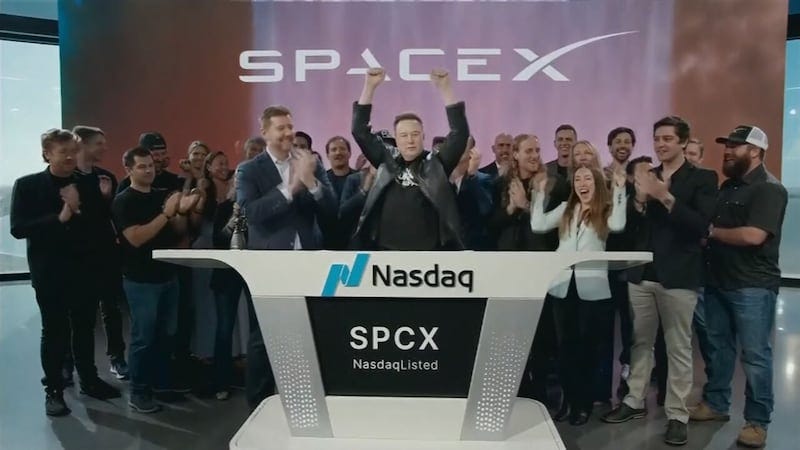
SpaceX’s IPO marks a structural transition in the space economy: from a market defined by a small number of government programs and speculative commercial ventures to one with a $1.77 trillion anchor company, a growing defense investment anchored by Golden Dome, and myriad active commercial developments of orbital data centers, in-space manufacturing, and autonomous in-orbit infrastructure.
The space infrastructure market, valued at $157.4 billion in 2026, is projected to grow to $373.7 billion by 2034. The enabling sub-markets, in-orbit servicing robotics, space-based compute, and new altitude regimes such as VLEO, are each growing at rates between 10% and 67% annually on current projections, reflecting early market formation dynamics rather than mature-market growth.
The capital allocation question the IPO raises is structural: as SpaceX transitions from a private vehicle to a public equity, institutional exposure to the broader space infrastructure stack through early-stage companies becomes the primary mechanism for accessing the pre-consensus formation phase of the orbital economy’s next layer of enablement.
With SpaceX entering the public markets, institutional attention is turning to the underlying infrastructure market the company helped create and to the segments of that market that remain in early formation.
The Space Economy: Current Scale and Growth Trajectory
The total global space economy was valued at approximately $626 billion in 2025, according to Novaspace’s twelfth annual Space Economy Report, roughly double its size a decade prior. The Space Foundation, using a separate methodology, put the global 2024 figure at $613 billion, and McKinsey and the World Economic Forum projected that the entire global sector will reach $1.8 trillion by 2035.
Government spending accounts for a substantial portion of this total. Global government space budgets reached $135 billion in 2024, with the United States responsible for approximately $79.7 billion, roughly 59% of worldwide government space expenditure. Defense applications represent the largest single segment of government spending: global defense space budgets reached $73 billion in 2024, a figure that is rising as multiple nations accelerate sovereign space capabilities.
Market Structure: A Word of Caution
The commercial NewSpace sector, including SpaceX, Rocket Lab, Planet, Maxar, and a growing roster of venture-backed startups developing launch services, satellite operations, and adjacent applications, are increasingly eating up a growing share of the space infrastructure market that’s been traditionally dominated by established primes like Lockheed, Northrup, and Boeing.
The in-orbit manufacturing market was valued at $1.21 billion in 2025 and is projected to reach $3.51 billion by 2030 at a 23.6% CAGR. The broader in-space manufacturing, servicing, and transportation market is projected to expand from $2.09 billion in 2025 to $5 billion by 2034.
Presently, while the markets appear bullish, Aexodus maintains a sober stance about the macro recessionary overhang. In market booms, SpaceX and its adjacent companies are built up and prosper. A rising tide raises all boats, as they say. When markets inevitably collapse, and they always do, the less prepared and the most financially exposed get wiped out. Space technology has extremely high upfront capital expenditures with decade-long horizons to profitability. Only a handful of startups will manage to survive a receding tide. Of the ones that do, the new incumbents attain a moat that few new entrants will ever cross.
It’s important to be mindful about making any space investment in the public markets at today’s retail values. We perceive the latter half of 2026 to represent a peak of the broader market cycle in actuality. We are instead observing this boom carefully and wisely, preparing to brave the repricing that lies ahead. The prescient question is: how far away is it, and how hard will it hit.
Defense Application: Golden Dome Initiative
The single largest new demand signal in the space infrastructure market is the Golden Dome missile defense initiative, established by executive order in January 2025 and seeded with an initial $24.4 billion through the 2025 reconciliation law. The program represents a strategic pivot toward space-based interceptors and persistent orbital sensing as the foundation of U.S. homeland defense.
The White House has pegged the program’s total cost at $175 billion, with the administration targeting a fully operational system in roughly three years. The Congressional Budget Office (CBO) has projected costs of roughly $1.2 trillion over 20 years, with the space-based interceptor layer accounting for approximately 70% of acquisition costs.
Orbital Data Centers Enable the AI Inference Layer
Beyond defense applications, the same space infrastructure can be applied toward dual-use in applications such as orbital data centers. The space-based data center market was valued at $1.28 billion in 2025 and is projected to reach $3.81 billion by 2034 at a 12.96% CAGR, according to Fortune Business Insights. Over 50% of planned satellite missions and space initiatives by 2030 are expected to incorporate robotic servicing or debris mitigation technologies, according to SNS Insider.
As of early 2025, 47 orbital computing payloads were in active development or had been launched, compared to just 3 in 2021. In January 2026, Axiom Space launched the first two orbital data center nodes to LEO, operating within Kepler Communications’ optical relay network with 2.5 Gbps optical links for Earth-independent processing. In December 2025, Nvidia-backed Starcloud successfully trained an AI model while in orbit using commercial H100 GPUs, the first empirical validation of orbital AI compute at commercial hardware specifications. SpaceX filed plans with the FCC in January 2026 for an orbital data center constellation of up to one million satellites. Venture capital investment in orbital data center startups has exceeded $1 billion cumulatively; in March 2026, Starcloud raised a $170 million Series A at a $1.1 billion valuation, making it the category’s first unicorn.
In-Orbit Assembly: A New Category of Spacecraft
Rendezvous Robotics, an Aexodus portfolio company, is pioneering a new category of spacecraft: intelligent modular systems that launch as individual tiles and autonomously assemble in orbit. Its spacecraft tiles integrate sensing, compute, power, control, autonomous docking, and electromagnetic assembly, enabling them to dock, self-correct, and form larger spacecraft platforms without human intervention.
The infrastructure enabling orbital data centers including power, thermal management, data relay, and physical assembly at scale, represents a distinct but critical infrastructure layer from the compute hardware itself. Low-latency data transport between orbital clusters and terrestrial networks is a critical dependency, as is the autonomous assembly capability required to build and operate structures at the aperture sizes needed for large-scale orbital compute.
The structural case for in-orbit assembly rests on a physical constraint: spacecraft are constrained by the launch vehicle’s fairing diameter. SpaceX’s Starship offers a 9-meter fairing, the largest commercially available. A thermal management radiator for a 100-kilowatt orbital data center requires the order of 100 square meters of surface area. The fairing constraint does not disappear with Starship. It shifts the threshold at which in-space assembly becomes necessary relative to pre-integrated launch.
Rendezvous is commercializing self-assembling spacecraft technology originally developed at MIT and advanced through multiple ISS demonstrations. The system has flown on two ISS missions, SpaceX CRS-20 in March 2020 and Axiom Ax-1 in April 2022. According to the company, those flights validated autonomous assembly over 30 days with more than 100 docking cycles, and error-correction work that improved docking success rates by 20 -30%
VLEO: The New Orbital Regime of Next Generation Space Infrastructure
Very Low Earth Orbit (VLEO), typically defined as 150 to 250 kilometers altitude, has historically been avoided for sustained operations precisely because of this constraint. Atmospheric density at 200 km creates continuous drag sufficient to deorbit a conventional satellite within weeks. Atomic oxygen at these altitudes corrodes exposed surfaces. Aerodynamic torques complicate attitude control. Traditional spacecraft address these challenges by carrying onboard propellant, which converts any low-altitude mission into a countdown to depletion.
The physics advantages of operating at this altitude, however, are considerable. For a sensor at only the 200 km band versus at the higher altitude band of 1,000 km, infrared target brightness increases by approximately ~20 times. Imaging resolution improves proportionally with altitude reduction for a fixed-aperture sensor. One-way signal propagation latency (measured) from 200 km in VLEO is approximately 10 ms, compared to 20-50 ms from 1,000 km LEO, 130-170 ms from medium Earth orbit (MEO), and 500-700 ms from geostationary (GEO) orbit. These differences are mission-relevant for time-critical applications including hypersonic threat tracking, fire control, and directed-energy cueing.
The Golden Dome architecture’s cost uncertainty is partly a function of orbital altitude. The CBO’s analysis of the space-based interceptor layer specifically notes that satellite lifetime in low-altitude regimes is constrained by atmospheric drag, making constellation replenishment a significant and ongoing expense. Cost aside, lower latency data transport between orbital compute and ground users is a potential commercial differentiator for latency-sensitive AI inference applications.
Vaxon Space, an Aexodus portfolio company, is developing an air-breathing electric propulsion (ABEP) satellite bus for the VLEO band. The company has filed provisional patents on its inlet and compression architecture. According to the company, its commercial wedge puts missile defense, Golden Dome-adjacent applications, and orbital data centers as the primary applications, with a $175 billion TAM, expanding to bus sales, ISR, AI connectivity, and low-latency relay applications as the platform matures.
ABEP is an emerging technology category designed to make sustained VLEO operations commercially viable. ABEP systems ingest residual atmospheric particles at orbital altitude, ionize them, and accelerate them electrically to generate thrust without carrying onboard reaction mass. The atmosphere that causes drag becomes the propellant source, enabling theoretical steady-state altitude maintenance in a regime that conventional propulsion cannot sustain.
ABEP as a category is not exclusive to Vaxon. ESA has funded ABEP research programs, and academic institutions including CU Boulder’s LASP and Rutgers are active in the VLEO environment. The technology is at an early readiness level across the industry, with no operational systems yet flown. U.S. Space Force officials have identified VLEO as a strategically relevant orbital regime. The service’s deputy chief science officer has said satellites operating below 250 kilometers could support a more resilient and survivable architecture, and congressional defense committees have directed the Space Force to explore commercial VLEO capabilities.
The VLEO and ABEP market has no established commercial incumbents with operational systems, representing an early-formation category. Adjacent academic and government programs have validated the physics; commercial operationalization remains in development.
Aexodus Capital is a seed-stage venture fund focused on physical AI, robotics, and sovereign infrastructure. Vaxon Space and Rendezvous Robotics are portfolio companies of Aexodus Capital Fund I. This article is for informational purposes only and does not constitute an offer to sell or solicitation of an offer to buy interests in any investment fund. Market data cited from Novaspace, Space Foundation, McKinsey, SNS Insider, Research and Markets, Fortune Business Insights, Grand View Research, Uptime Institute, Mordor Intelligence, and Breaking Defense. Past performance is not indicative of future results.