
The Shipbuilding Bull Run and the Picks-and-Shovels Playbook
The welder shortage, the US-China shipbuilding gap, and where we see physical AI being deployed


This is the first of a series of (roughly) monthly insights coming straight from the deal room—a synthesis of the data Aexodus is seeing under the hood from private markets that most don’t.
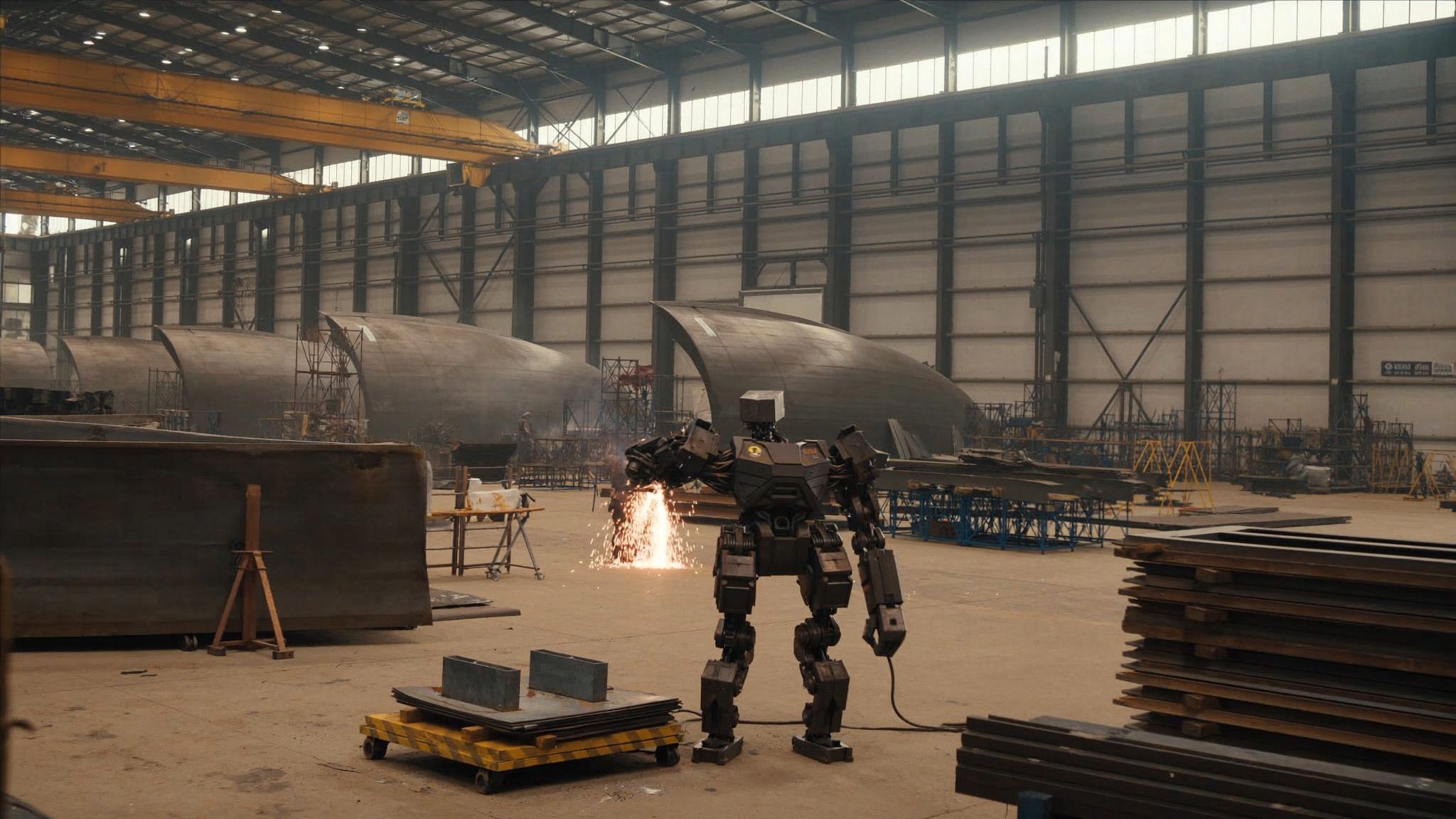
Real labor gaps, exacerbated by long-horizon global birthrate declines, is central to our fund thesis, and teams who can bridge the gap with commercially-viable, intelligent physical automation integrations are the ones we back. This month, we are highlighting a market opportunity in one overlooked place: the shipyard.
Here’s how the traditional shipyard workflow has been done in the past for one ship (an up to 9-year project) and where robots can come in:
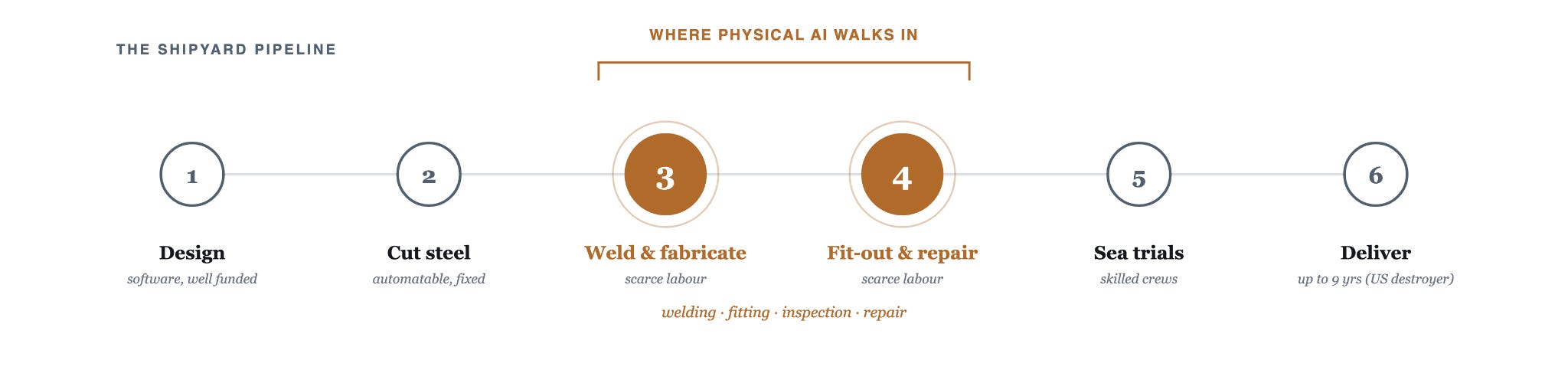
Three fundamentals:
Labor shortage drives demand. There aren’t enough young laborers to replace the aging 40+ year-old shipbuilding laborers for the requisite specialized, dangerous, and unglamorous tasks like welding. That is fundamentally what’s underpinning demand for robots to buttress the labor gap today; not someday.
Humanoids must start specialized; not generalized. High-skilled, high margin work needs specialization. Humanoids are touted as general-purpose machines, but that vision just isn’t possible today (from a technical feasibility angle—more on that in a future article).
Threats of conflict drives maritime demand. Historically, the global shipping industry had been steady, dotted by short 3-4 year bursts of activity (1999-2001 and 2004-2008). With the closing of the Straight of Hormuz, however, this has spurred a bull cycle for the global shipping industry, with South Korea emerging as a winner amidst the chaos.
WHY A HUMANOID, AND WHY HERE
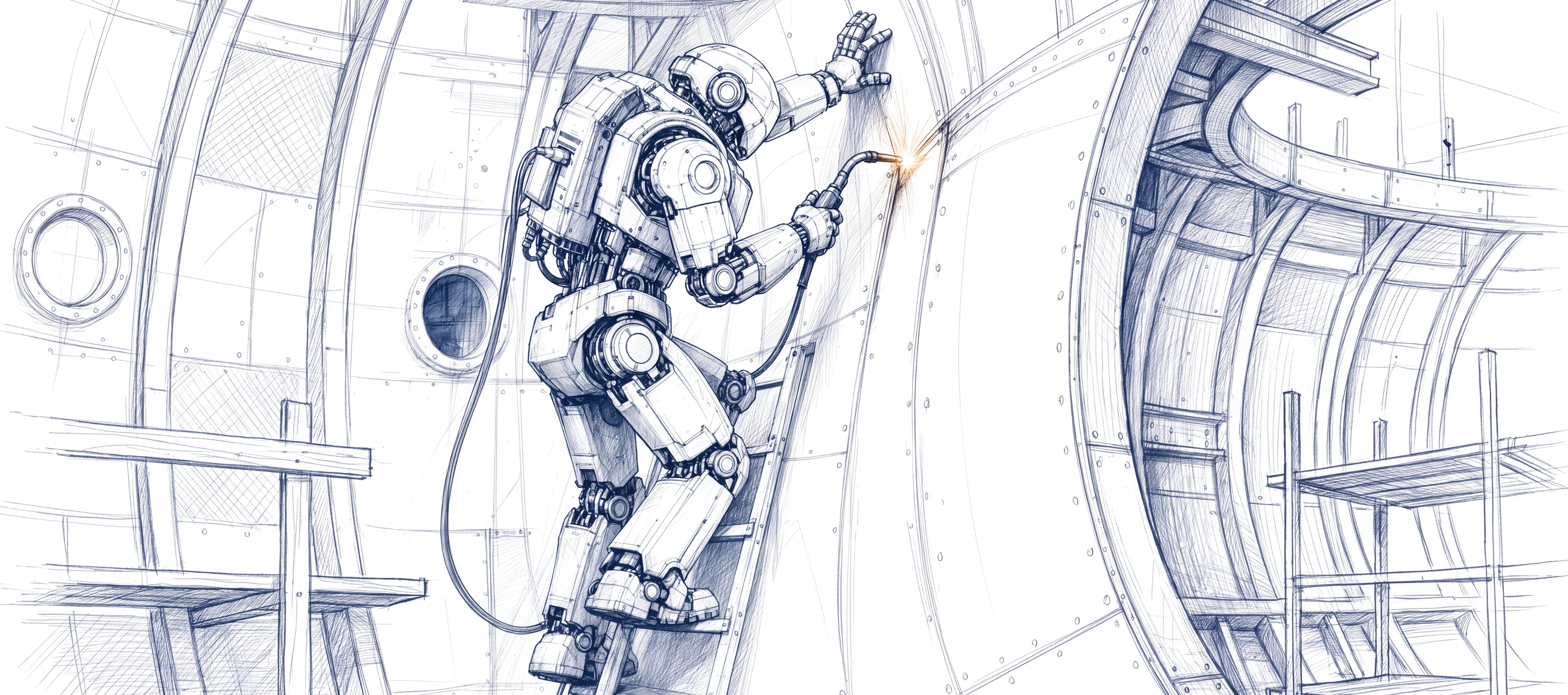
A shipyard is built around people: their reach and balance, the ladders, the scaffolding, the tight access. ABS makes the point itself that humanoids suit spaces designed for human workers, including confined and awkward spaces that fixed welding cells a la Path Robotics just can’t sufficiently service alone. This answers the usual objection to legs and hands, that a simpler robot or fixed assembly line arms would do. In a shipyard, moving and manipulating are all part of the job.
The bar to payoff is lower than it looks. A yard does not need a robot to replace a full-time welder’s entire job category. One that can run repeatable weld passes, carry inspection sensors, log usable data, or hold a hard position for part of a shift already unlocks more out of the existing skilled people in the workforce. The first win is simple: more output while incurring less injuries per welder.
THE WELDER SHORTAGE NO ONE CAN HIRE THEIR WAY OUT OF
The American Welding Society projects the country needs 320,500 new welders by 2029 just to keep up. That’s a gap hiring alone won’t close, in work that is dangerous, hard to staff, and rife with attrition.
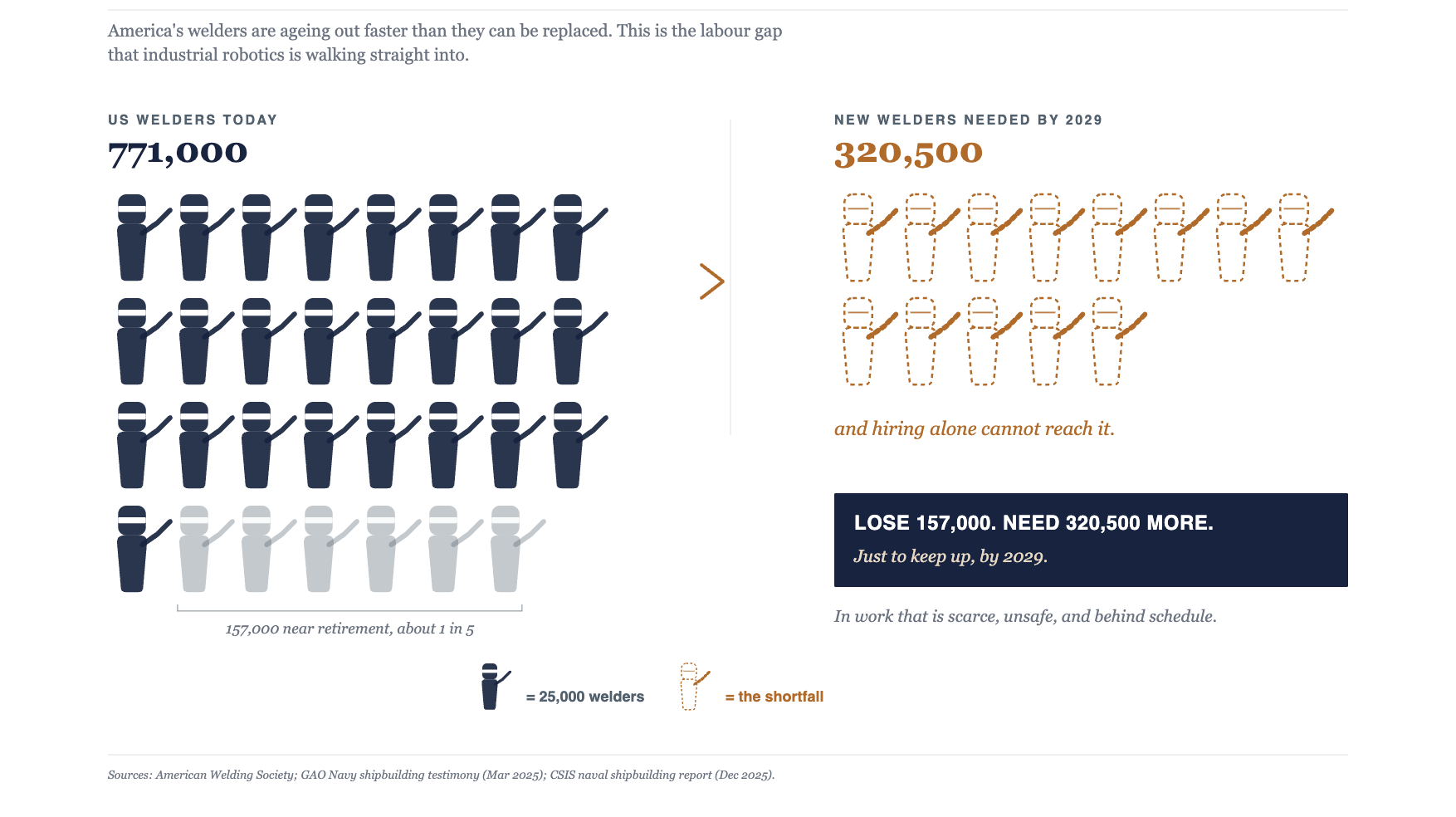
GAO’s March 2025 Navy shipbuilding testimony says workforce and infrastructure limits are dragging on shipbuilding performance, and that yards are struggling to replace experienced skilled workers. CSIS’s December 2025 report goes further, describing a US naval shipbuilding enterprise that cannot produce at the scale, speed, or cost now being demanded of it.
THE BIGGER PICTURE
The macro market and geopolitical backdrop has created a tailwind for global shipping that wasn’t present just two years earlier. Shipbuilding saw a run when the Strait of Hormuz closed in early 2026. The IEA called the resulting oil-supply shock the largest disruption in the history of the oil market, where the resulting scramble for oil and ships shot VLCC (Very Large Crude Carrier) demand through the roof.
A US guided-missile destroyer can take up to nine years to deliver. Automation in this use case is one of the credible ways to scale capacity, cut build times, all while maintaining costs at par with traditional methods, even given the lack of laborers.
We see the market starting to fill out with startups addressing the demand. Blue Water Autonomy, Saronic, BlackSea, and Anduril are all in the water. Saronic has the most capital, the largest shipyard footprint, and the only large-scale Navy production contract among the list so far. The rising tide of US federal government demand is, invariably, raising all boats as it were.
CHINA BUILDS MOST OF THE SHIPS
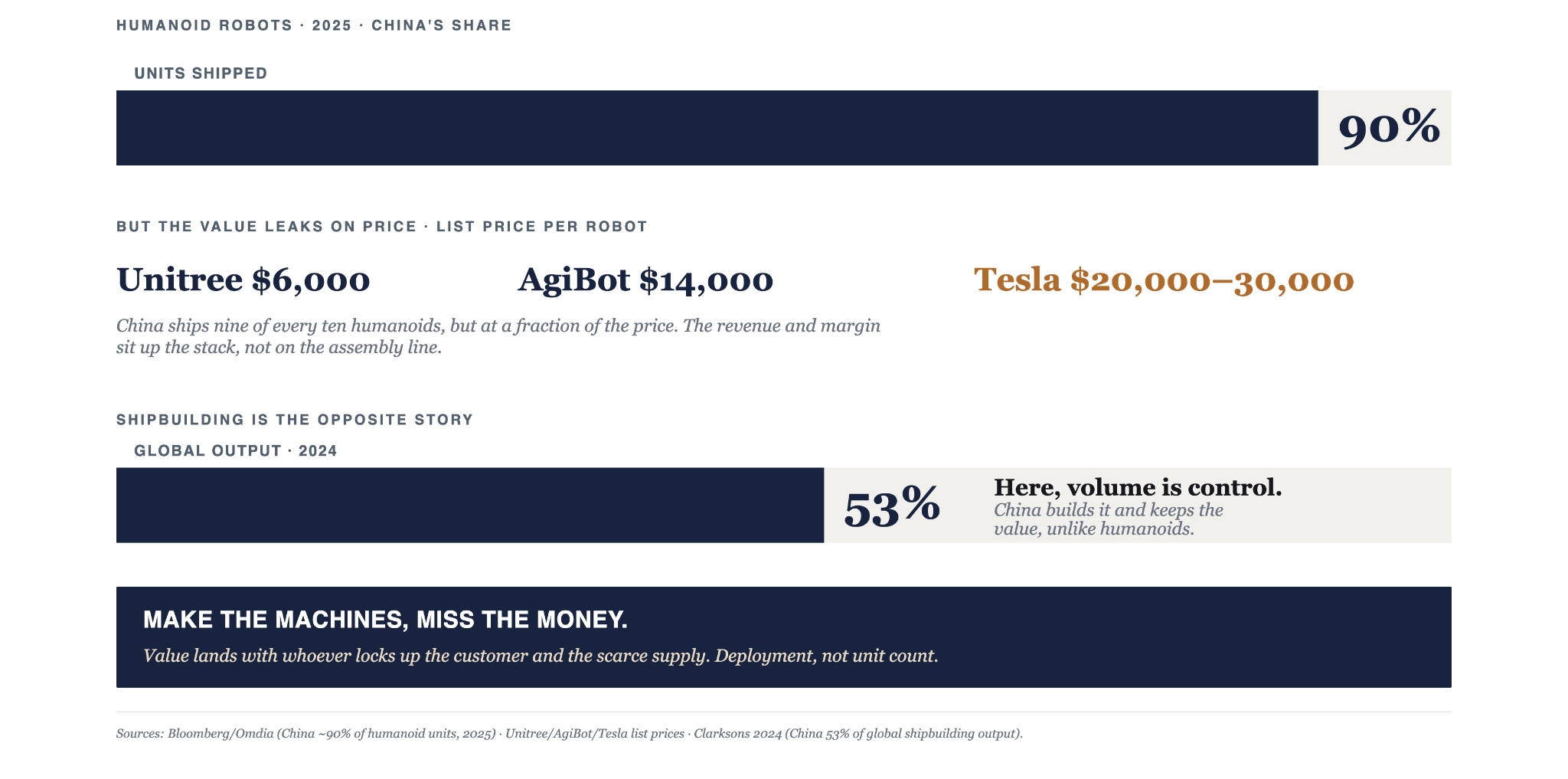
In 2024 China took 53% of global shipbuilding output by tonnage and roughly two-thirds of all new orders, and remains the only major producer still expanding capacity. The gap is stark: over the past decade, Chinese yards delivered 6,765 commercial ships to the United States’ 37.
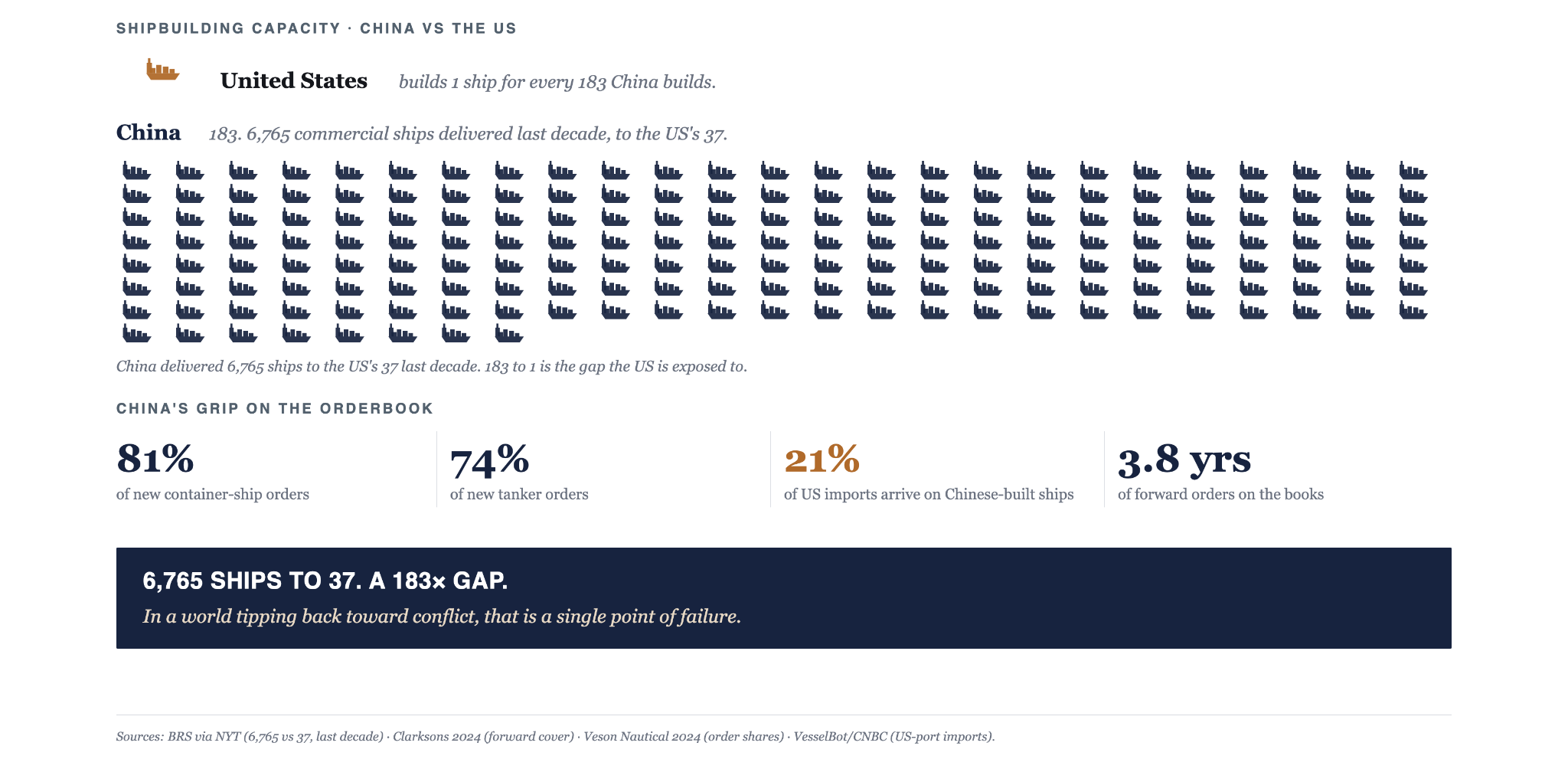
Chinese yards are sitting on close to four years of forward orders. By segment, Chinese yards took 81% of new containership orders and 74% of new tanker orders that year. The US does not buy from Chinese yards directly, but its supply chain exposure is dubiously wide open. About one in five of the goods imported into the US in 2024 arrived on a Chinese-built ship.
In a world teetering on the edge of conflict, that is a single point of failure. The COVID-era supply-chain snarls were only a preview of what happens if those routes are cut.
ENTER KOREA
South Korea is the world’s second largest shipbuilder by order value, and is the country the US is leaning on as a drop-in for China. Toward the end of 2025, as the industry experienced whiplash from the on-again, off-again tariffs, South Korean shipyards emerged as the winners as the market braced for punitive tariffs that President Trump might impose on Chinese ships calling US ports.
South Korea still owns LNG, holding 62% of new carrier orders in 2024 to China’s 38%, and its tanker orderbook is recovering after falling from 54% to 16% between 2021 and 2024. The Big Three, HD Hyundai, Samsung, and Hanwha, are all moving into the US naval and repair market, each having signed a US defense or shipyard partner in 2025. Hanwha buying Philly Shipyard is the clearest tell.
THE DARK HORSE
If the humanoid race is won in the 2030s by whoever achieves reliability, autonomy, generalization, and scale without running out of money first, the race, we anticipate, will rhyme with how frontier AI labs has unfolded: a concentration of North American winners and a slightly longer list of Chinese competitors, with Chinese EV companies as some of the frontrunners.
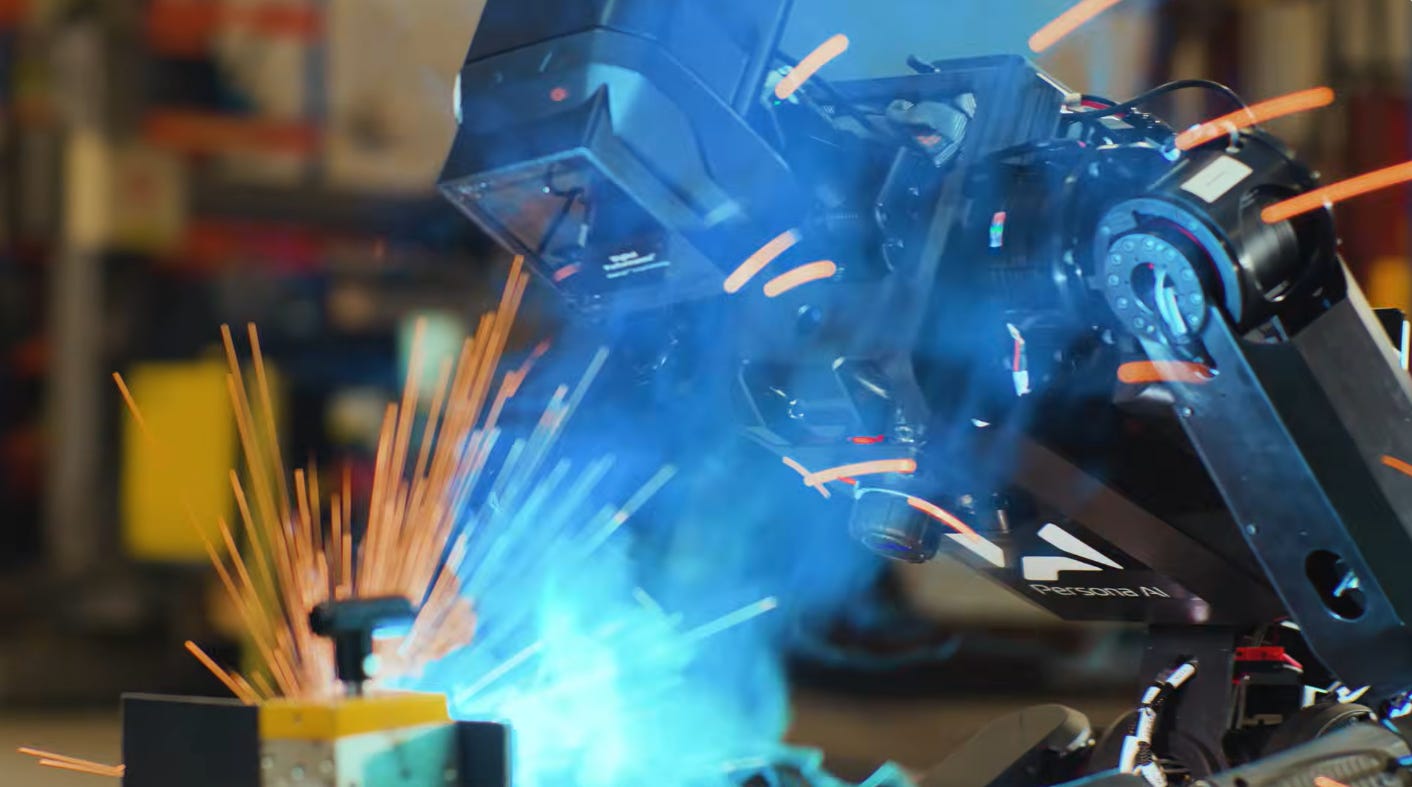
One team building directly for the shipbuilding labor gap is Persona AI, based in Houston, TX. It manufactures humanoid robots for heavy industry, by aiming toward creating the world’s largest repository of industrialized skills and tool usage like welding, grinding, painting, cutting, assembling, and other critical tasks. We would underwrite Persona as a picks-and-shovels play for the growing demand in shipbuilding as opposed to a pure humanoid play where narrative-driven valuations have far exceeded fundamentals.
The company’s financial projections are thus: a bill of materials (BOM) around $50k at scale against a robot-as-a-service (RaaS) price of $75k-$100k per unit a year. Persona reports their humanoids having a best-in-class 2kWh battery, good for over 4 hours of aggressive runtime and can last longer with lower grade work. They were designed for fast battery swaps where thermal performance is optimized for continuous operation.
Persona has signed an agreement with HD Hyundai’s shipbuilding group to deploy robots into their shipyards. Its second-generation prototype is currently welding and walking, and it is targeting first deployments in 2027, working with marquee partners including POSCO and ABS. The founders have built this class of machine before: CEO, Nic Radford, led NASA’s humanoid work, including the Valkyrie program, then founded Nauticus and Boardwalk Robotics, which got acquired by Foundation. CTO, Jerry Pratt, was formerly the CTO of Figure AI and a fellow NASA alumni to Nic during their tenure at Johnson Space Center together.
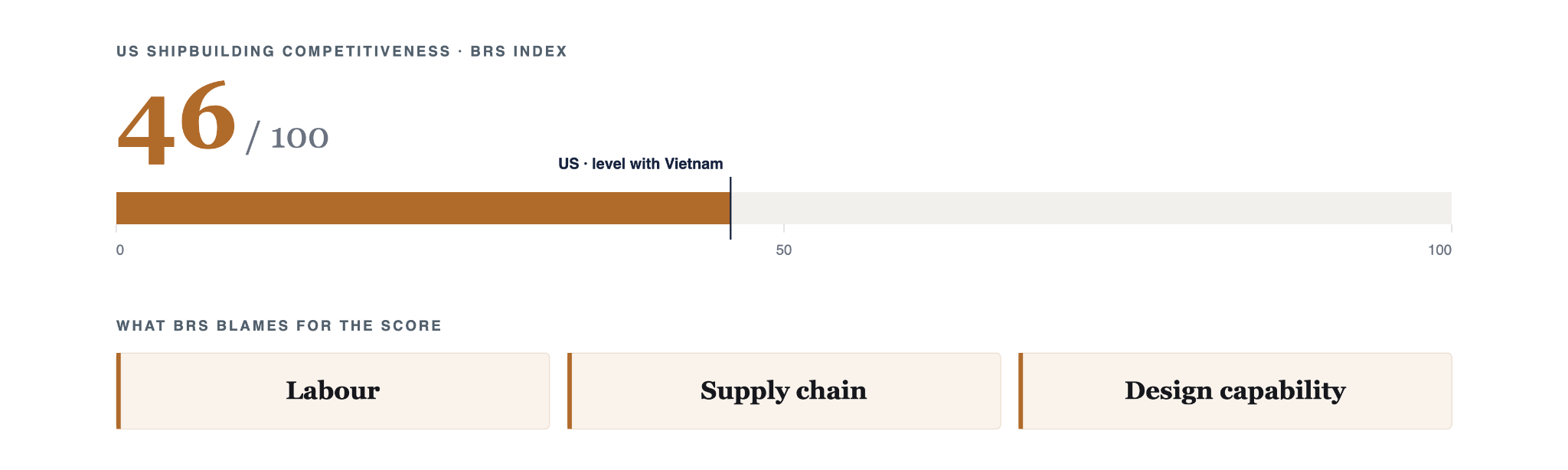
The US’ weak shipbuilding competitiveness score is the gap that Persona is built for. BRS scores US shipbuilding competitiveness at 46 out of 100, level with Vietnam, citing labor, supply chain, and design capability as variables in the scoring. That supply gap is the very chasm that Persona, Path Robotics, Saronic, and the MASGA policy push are all aiming to bridge.
WHERE THIS GOES NEXT
Morgan Stanley projects the humanoid market could reach $5 trillion by 2050, if more than a billion units are in use. China alone shipped roughly 90% of the world’s humanoids in 2025, but captured only 30% of the dollars because hardware will inevitably get commoditized.
The capital behind humanoids is betting on the directionality of where robotics is going as a whole. Figure AI, Skild, Apptronik, Agility, Neura, Physical Intelligence, and Boston Dynamics have all taken money from strategic industrials, Mag 7 companies, and AI and AI-adjacent VCs. Many of the backers like Toyota, Nvidia, Amazon, Samsung, SoftBank, Foxconn, Hyundai read like they’re hiring external robotics companies that may become acquisition targets. That matters because the late-stage outcomes here are likely to result in RaaS exits, M&A deals, secondaries offerings, or, in Agility’s case, SPAC IPOs.
The demand is coming from industrial buyers. The physical AI startups who can secure contracts with customers early (as in, now), deploy their hardware into those idiosyncratic environments, accumulate and compound the data collected on-site, integrate their software into legacy workflows, who ultimately achieve vendor lock-in are the teams we are backing to make it past the 10-year event horizon. Surviving beyond that point very probably means becoming the sector’s future incumbents.
For Aexodus, because we think of physical AI as a tool to augment the skilled labor gap that is currently below workforce replacement, exposure here means owning a slice of future GDP that the post-manual world is ultimately going to depend on.
This does leave us with an open question to ponder about stepping into the ensuing decade: could the US doubling down on physical AI stand to re-shore commercial shipbuilding domestically, or would that still not be enough to stop outsourcing its needs to countries like South Korea?
If any of this was useful, forward it to someone who’d find it interesting. That’s how the newsletter grows.
Invest in this space? We keep a smaller circle for people building and backing physical AI. Reply to this email, tell us who you are and we will be in touch.
Until next month,
The Aexodus team

Disclosure: Aexodus is an investor in Persona AI and Agility Robotics.
This material is for informational purposes only and does not constitute an offer to sell or a solicitation of an offer to buy any security. Any offer will be made only pursuant to definitive offering documents. Investing involves substantial risk, including possible loss of all capital. Past performance is not indicative of future results.
They say the real winners of the Gold Rush sold picks and shovels. Today, it’s those selling autonomous welding systems!